
Selling supplements online can be a strong opportunity for ecommerce brands, but shipping supplements to the U.S. involves more than simply finding a carrier and sending packages.
Dietary supplements are regulated as a category of food under U.S. law, and imported products must meet applicable FDA requirements. This means ecommerce sellers need to think about product compliance, labeling, packaging, documentation, shipping channels, and fulfillment before scaling sales.
For Shopify, WooCommerce, Amazon, or other ecommerce brands, understanding these requirements early can help reduce shipping delays, customs issues, damaged products, and customer complaints.
Here are 7 things to consider when shipping supplements to the U.S.
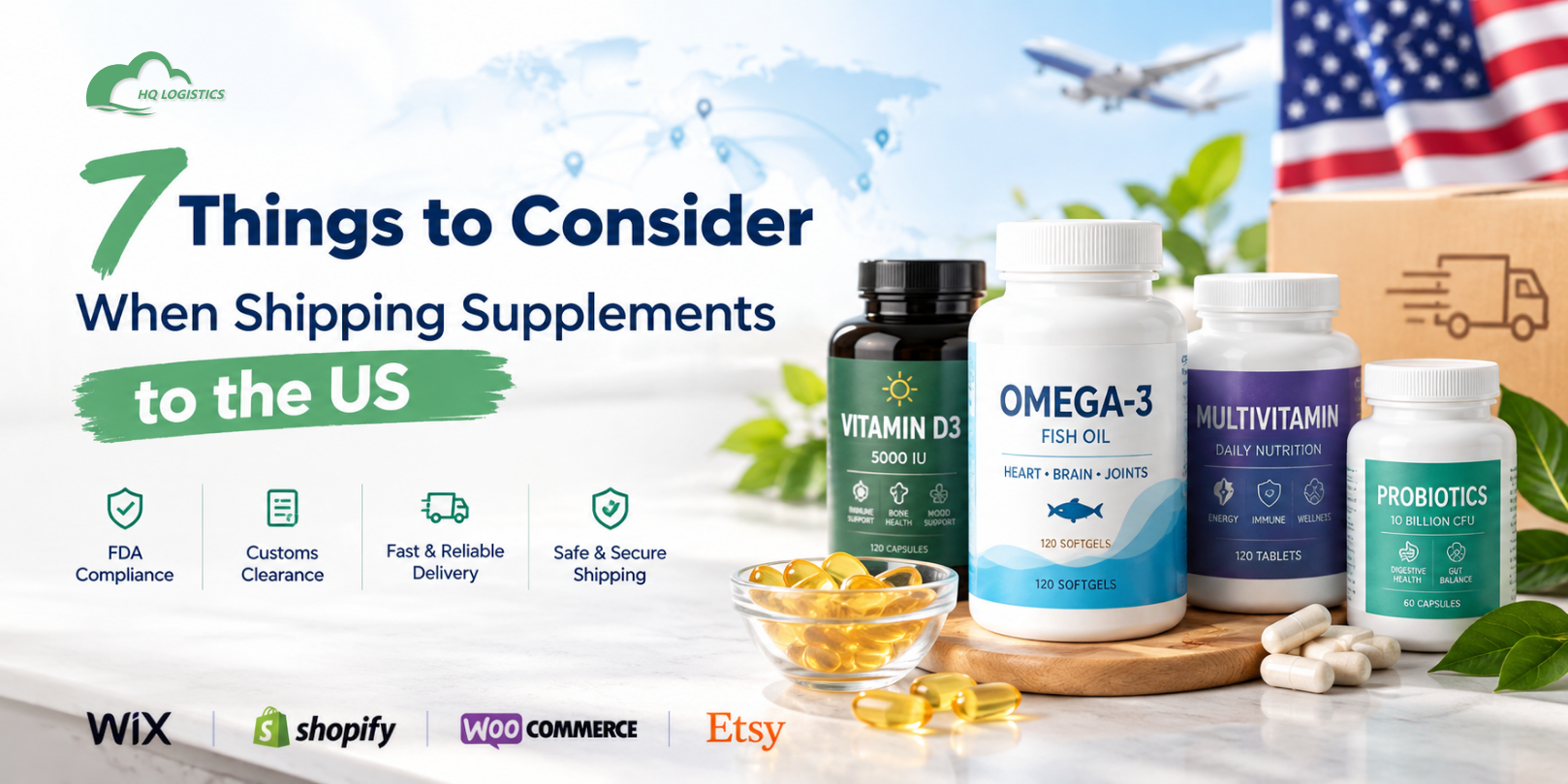
Before choosing a shipping method, first make sure you understand how your product is classified.
Dietary supplements can include products containing vitamins, minerals, herbs or other botanicals, amino acids, and certain other dietary substances. However, not every health-related product is automatically treated as a dietary supplement.
The classification of a product can affect its regulatory requirements, labeling, claims, and import process.
For example, a product marketed as a supplement should not be promoted as a treatment or cure for a disease simply because the product contains certain ingredients.
FDA explains that dietary supplement manufacturers and distributors are responsible for ensuring their products are not adulterated, misbranded, or otherwise in violation of federal law.
Before shipping, sellers should review:
Product ingredients | Product format | Intended use | Marketing claims | Target customers | Country of manufacture
If you are sourcing supplements internationally, it is also important to work with suppliers that can provide accurate product and ingredient information.
Labeling is one of the most important considerations when shipping supplements to the U.S.
FDA requirements generally include information such as the product identity, net quantity, Supplement Facts panel, ingredient information, and the name and place of business of the manufacturer, packer, or distributor.
Depending on the product, the label may also need information such as:
Serving size | Number of servings | Dietary ingredients | Amount per serving | Other ingredients | Domestic contact information for serious adverse event reporting
This means a product that is properly packaged for another market may still require changes before it is sold in the U.S.
For ecommerce brands, it is better to check the packaging and labeling requirements before placing a large inventory order.
Your fulfillment partner may handle storage, picking, packing, and shipping, but the seller remains responsible for making sure the product complies with applicable requirements.
A good fulfillment workflow should therefore include a packaging and labeling check before inventory is shipped to customers.
Supplement marketing claims deserve special attention.
There is an important difference between a structure/function claim and a disease claim.
For example, a claim describing how a nutrient supports a normal body function can fall under the structure/function framework. By contrast, saying that a supplement diagnoses, treats, cures, or prevents a disease can create very different regulatory issues.
FDA states that certain structure/function and related claims must be truthful and not misleading, supported by substantiation, accompanied by the required disclaimer, and notified to FDA within 30 days after first marketing when the applicable requirements apply.
For this reason, ecommerce sellers should review more than the text printed on the bottle.
Your product page, advertising, packaging, inserts, and other marketing materials should also be reviewed carefully.
Before launching a supplement product, check:
Product packaging | Shopify product page | Amazon listing | Advertising copy | Social media claims | Customer inserts
The safest approach is to make sure your product claims are accurate, supportable, and appropriate for the regulatory category.
When sourcing supplements from overseas, supplier selection becomes especially important.
FDA states that facilities that manufacture, process, pack, or hold dietary supplements or dietary ingredients for consumption in the U.S. are subject to FDA registration requirements. FDA also has specific current good manufacturing practice requirements for dietary supplements under 21 CFR Part 111.
This means ecommerce brands should look beyond the supplier's product catalog and price.
Before working with a supplement supplier, consider checking:
Manufacturing facility information | Ingredient specifications | Product documentation | Quality control procedures | Batch information | Packaging standards | Available testing documentation | Production capacity
A reliable supplier can also make it easier to maintain consistent product quality as your order volume grows.
Growing supplement brands can also benefit from having access to multiple qualified suppliers.
If one supplier experiences production delays, raw-material shortages, or quality problems, having alternative sourcing options can provide additional supply-chain flexibility.
This is one reason a fulfillment partner with sourcing capabilities can be useful for growing supplement brands.
Shipping supplements to the U.S. is not simply a standard parcel-delivery process.
Because dietary supplements fall under food regulations, imported shipments can be subject to FDA import requirements. FDA states that imported food must comply with U.S. requirements, and facilities involved in manufacturing, processing, packing, or holding regulated food may need to be registered with FDA. Imported food shipments are also generally subject to Prior Notice requirements unless an exemption applies.
Prior Notice gives FDA information about an incoming food shipment before it arrives in the United States.
The information can include details such as:
Manufacturer information | Product information | Quantity | FDA product information | Shipment information | Facility registration information when applicable
The exact process depends on the shipment and entry method, so sellers should work with an experienced customs broker, importer, or logistics provider when needed.
A common mistake is choosing a shipping channel based only on price and delivery speed.
For supplements, the shipping solution should also consider regulatory requirements, documentation, product characteristics, destination, and customs procedures.
A slightly cheaper shipping method may not be the better choice if it creates more delays or compliance risks.
Supplements need packaging that protects the product throughout the fulfillment and shipping process.
Different supplement formats may have different packaging considerations.
Capsules and tablets | Gummies | Powder supplements | Liquid supplements | Sachets | Softgels
For example, temperature, moisture, pressure, leakage, and physical impact may affect certain products differently.
Your fulfillment process should consider the original product packaging as well as the outer shipping package.
For growing supplement brands, useful packaging services can include:
Product inspection | Protective packaging | Custom boxes | Branded inserts | Thank-you cards | Custom labels | Product photography | Repacking
If you are building a supplement brand rather than simply reselling a generic product, customized packaging can also help create a more consistent customer experience.
The biggest challenge may not be shipping your first 50 orders.
It is shipping hundreds or thousands of orders consistently.
As order volume increases, supplement brands need a fulfillment system that can manage inventory, quality checks, packaging, order processing, and shipping without creating unnecessary delays.
A scalable workflow can look like:
Product sourcing → Supplier verification → Sample inspection → Inventory planning → Quality check → Custom packaging → Warehouse storage → Order fulfillment → U.S. shipping → Tracking
This is where a dedicated fulfillment partner can become more valuable than simply using a low-cost shipping agent.
For supplement brands, HQ can support sourcing, supplier coordination, quality inspection, packaging, warehouse storage, order fulfillment, and U.S. shipping.
HQ also provides supplement-focused fulfillment and packaging support for brands that need a more integrated supply-chain solution.
If your supplement brand has consistent U.S. sales, storing inventory closer to customers can become part of your fulfillment strategy.
Instead of shipping every order internationally from China, brands can consider moving suitable inventory into a U.S. warehouse and fulfilling domestic orders locally.
This can help simplify the final delivery process and provide a more scalable fulfillment structure as U.S. order volume grows.
The right strategy depends on your order volume, inventory turnover, product requirements, and shipping economics.
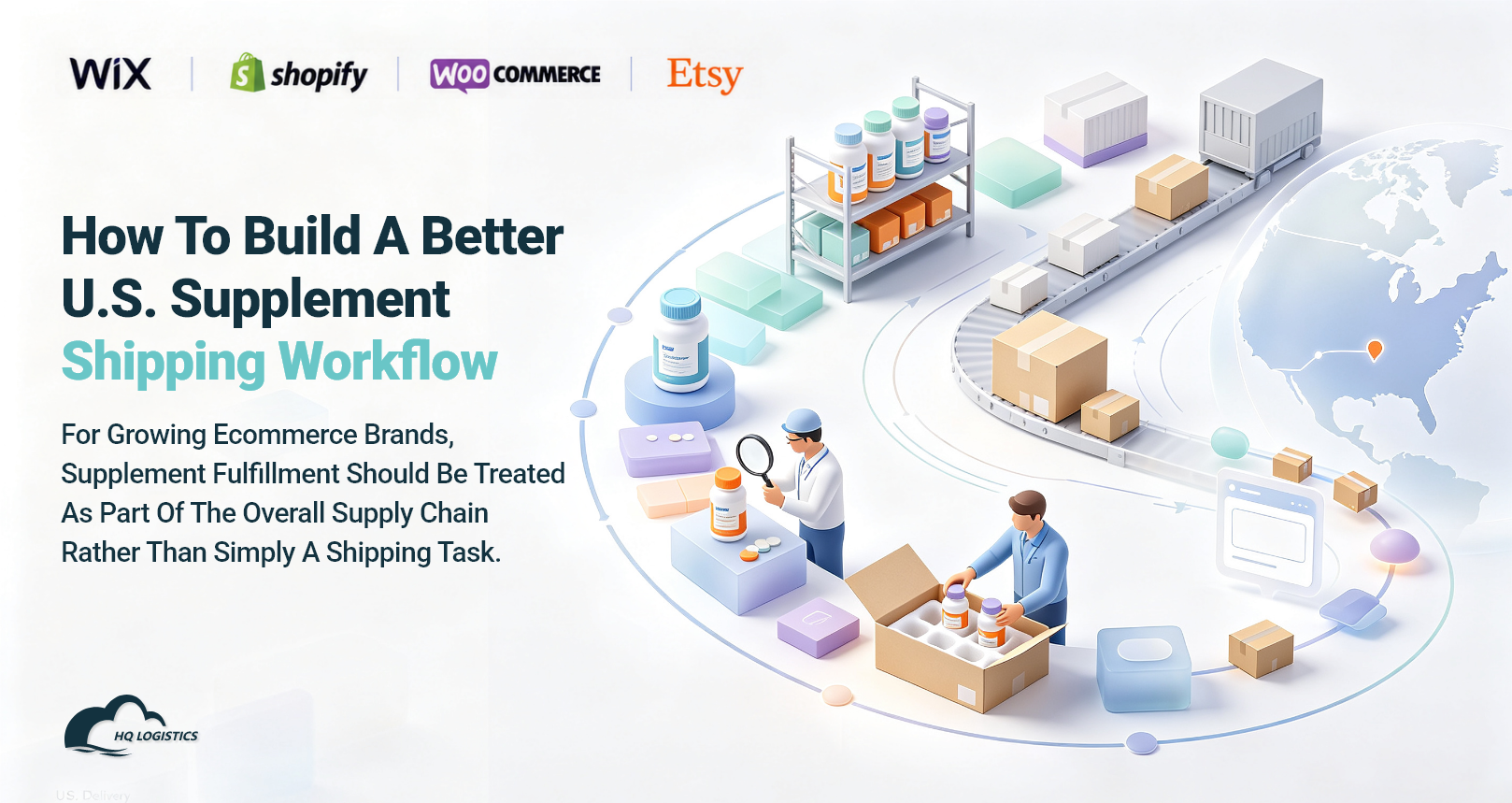
For growing ecommerce brands, supplement fulfillment should be treated as part of the overall supply chain rather than simply a shipping task.
A practical workflow is:
1. Product Review
Check ingredients, product classification, packaging, and intended market.
2. Supplier Verification
Review supplier capabilities, manufacturing information, quality processes, and documentation.
3. Sample Testing
Order samples before committing to large inventory quantities.
4. Compliance Review
Check applicable FDA requirements, labeling, claims, and import procedures.
5. Quality Inspection
Inspect products before they enter your fulfillment inventory.
6. Packaging Setup
Prepare protective and branded packaging based on the product and customer experience.
7. Inventory Planning
Decide whether to fulfill from China, use a U.S. warehouse, or combine both strategies.
8. Order Fulfillment
Connect your ecommerce store with the fulfillment system and automate order processing where possible.
9. U.S. Delivery
Choose shipping channels based on product characteristics, destination, cost, delivery expectations, and applicable requirements.
A traditional shipping agent may focus mainly on moving packages from one country to another.
Growing supplement brands often need more.
They may need sourcing support, supplier coordination, product inspection, packaging customization, inventory management, warehouse fulfillment, and multiple shipping options.
This is where a more integrated fulfillment model can help.
With HQ, supplement brands can combine:
Supplier Sourcing | Quality Inspection | Custom Packaging | Warehouse Storage | Order Fulfillment | U.S. Shipping
The goal is not simply to ship supplements faster.
It is to build a fulfillment system that can support the brand as its order volume grows.
Shipping supplements to the U.S. requires more planning than shipping many ordinary ecommerce products.
Before launching or scaling a supplement brand, pay attention to product classification, labeling, marketing claims, supplier quality, FDA import requirements, packaging, and fulfillment capacity.
A strong supply chain can help you manage these operational requirements while keeping inventory and delivery more predictable.
For brands selling supplements in the U.S., the right fulfillment partner can connect sourcing, quality control, packaging, warehousing, and shipping into one system.
If your supplement brand is growing, build your fulfillment strategy before your order volume becomes a problem.

Yes, supplements can be imported into the U.S., but the products and facilities involved must meet applicable U.S. requirements. Imported food is subject to FDA requirements, including applicable facility registration and Prior Notice requirements.
FDA generally does not pre-approve individual dietary supplements or their labels before marketing. However, manufacturers and distributors are responsible for ensuring that products comply with applicable federal requirements. Certain new dietary ingredients and claims have additional notification requirements.
Depending on the product, required information generally includes the product identity, net quantity, Supplement Facts, ingredient information, and manufacturer, packer, or distributor information.
Supplement claims must comply with applicable FDA requirements. Certain structure/function claims have specific substantiation, disclaimer, and notification requirements, while disease-related claims can be subject to different rules.
A U.S. warehouse can make sense when a brand has consistent U.S. demand and sufficient inventory volume. It can allow domestic fulfillment after inventory has been properly imported and stored. The best setup depends on sales volume, inventory turnover, product requirements, and total fulfillment cost.
Look at manufacturing capabilities, product documentation, quality control, ingredient information, packaging, production capacity, and the supplier's ability to maintain consistent quality as your business grows.
Yes. Depending on the fulfillment provider, services may include product inspection, repacking, custom boxes, branded inserts, labels, warehouse storage, order fulfillment, and shipping. For supplements, the packaging workflow should be designed around both product protection and applicable labeling requirements.
📩Email: zoye@fulfllment-cn.com
PREVIOUS RECOMMENDATIONS


Supplement Fulfillment in the U.S. | U.S. Warehouse Fulfillment | Custom Supplement Packaging | China-to-U.S. Fulfillment | Ecommerce Product Sourcing




Customer's favorable comments is our eternal motivation. We feel grateful for all the support and company.

Lorem ipsum dolor sit amet, consetetur sadipscing elitr, sed diam nonumy eirmod tempor invidunt ut labore et dolore magna aliquyam erat, sed diam voluptua.