
Q4 is one of the busiest periods of the year for ecommerce.
As order volume increases during Halloween, Black Friday, Cyber Monday, Christmas, and year-end promotions, shipping becomes more important than ever.
Choosing the wrong shipping route can lead to higher costs, longer delivery times, delayed orders, and unhappy customers.
For growing Shopify and ecommerce brands, the cheapest shipping route is not always the best option.
The right route should balance cost, delivery speed, product requirements, destination, order volume, and peak-season reliability.
In this guide, we'll explain how to choose the right shipping route for Q4 and how to prepare your fulfillment strategy before order volume increases.

During normal periods, a small shipping delay may be manageable.
During Q4, the same delay can cause much bigger problems.
Customers may be ordering products for specific holidays or events. If an order arrives after Halloween, Black Friday promotions, or Christmas, the customer may no longer need it.
At the same time, shipping networks become busier as ecommerce order volumes increase.
This can create:
Longer transit times: Peak-season transportation networks can become more congested.
Higher shipping costs: Urgent shipments and limited capacity can increase costs.
Delivery uncertainty: Estimated transit times may become less predictable.
Inventory pressure: Delays can prevent warehouses from replenishing popular products on time.
Customer service problems: Late deliveries can lead to more inquiries, refunds, and negative reviews.
That is why Q4 shipping planning should happen before the peak begins.
Delivery speed should be one of your first considerations.
A product purchased in October for Halloween has a very different delivery requirement from a product purchased in November for general use.
For Q4, consider:
Order processing time + Transit time + Possible delay buffer = Expected delivery window
For eligible products and routes, HQ offers shipping options with delivery times of approximately 3–8 days.
Fast delivery can be particularly valuable for seasonal products, promotional campaigns, and customers who are shopping close to important holidays.
However, sellers should always confirm the actual route, product eligibility, destination, and estimated delivery time before making delivery promises.
Shipping price should not be evaluated based only on the quoted rate per kilogram.
You should consider the complete fulfillment cost.
This may include:
Product sourcing → Warehouse receiving → Storage → Picking → Packing → Shipping → Final-mile delivery
A route with a slightly higher shipping rate may still be more cost-effective if it provides faster delivery, fewer handling steps, or better fulfillment stability.
For growing brands, compare the total landed fulfillment cost rather than only the transportation rate.
Not every product can use the same shipping route.
Product characteristics can affect route selection.
For example:
General products: Often have the widest range of shipping options.
Battery products: May require specific transportation solutions and packaging.
Liquids or creams: May require additional product and route checks.
Magnetic products: May require special handling depending on the route.
Large or heavy products: Can have significantly different shipping costs and route options.
Before choosing a route, confirm that the product is accepted and that the packaging meets the requirements.
This is particularly important when adding new products during Q4.
Your shipping strategy should match where your customers are located.
A route that works well for U.S. orders may not be the best choice for Europe, the UK, Australia, or New Zealand.
Consider:
Customer location | Local delivery expectations | Customs requirements | Shipping cost | Transit time | Local fulfillment options
For brands with concentrated demand in one market, overseas warehousing can also become a valuable option.
Instead of shipping every order internationally, sellers can position selected inventory closer to their customers and use local fulfillment for eligible orders.
Shipping requirements can change as your business grows.
A route that works well for 10 orders per day may not be the best solution for 500 orders per day.
Higher order volume may create opportunities for:
Better shipping rates | Consolidated transportation | Dedicated logistics solutions | Overseas warehousing | More efficient fulfillment workflows
Before Q4, review your expected daily order volume and discuss volume-based shipping options with your fulfillment partner.
The goal is to make sure your shipping strategy can scale together with your sales.
A shipping route should not only be fast.
It should also be reliable when order volume increases.
Ask your logistics partner:
Can this route handle higher Q4 volume?
Are there backup routes available?
What happens if transportation capacity becomes limited?
Can inventory be moved to an overseas warehouse?
How will delayed shipments be handled?
Having a backup option can be especially important for your best-selling products.
You don't necessarily need multiple routes for every SKU, but your highest-priority products should have a contingency plan.
Customers expect to know where their orders are.
Real-time tracking can help reduce customer uncertainty and make it easier for your support team to identify delayed shipments.
Your fulfillment system should ideally connect:
Store Order → Warehouse Processing → Shipment → Tracking Number → Customer
Better visibility also helps sellers identify problems earlier.
If a specific route starts showing longer transit times, you can adjust inventory allocation or switch eligible orders to another shipping solution.
There is no single shipping route that works for every ecommerce brand.
Instead, consider using different strategies for different products and markets.
Products are shipped directly from the origin warehouse to the customer.
This can be useful for:
New products | Low-volume SKUs | Long-tail products | Products with uncertain demand
The main advantage is that sellers do not need to pre-position large quantities of inventory overseas.
However, delivery times and shipping costs should be evaluated carefully during Q4.
For products with predictable demand, sellers can move inventory closer to customers before the peak season.
For example:
China Warehouse → U.S. Warehouse → U.S. Customer
This can reduce the distance between inventory and customers and support faster local fulfillment.
For European markets, an EU warehouse can similarly help position inventory closer to customers across multiple EU destinations.
The best products for overseas warehousing are usually proven bestsellers with predictable demand.
A hybrid strategy combines different fulfillment methods.
For example:
Best sellers → Overseas warehouse
New products → China warehouse
Long-tail products → Direct international shipping
This can help reduce inventory risk while keeping high-demand products closer to customers.
For many growing ecommerce brands, a hybrid strategy can be more flexible than moving the entire catalog overseas.
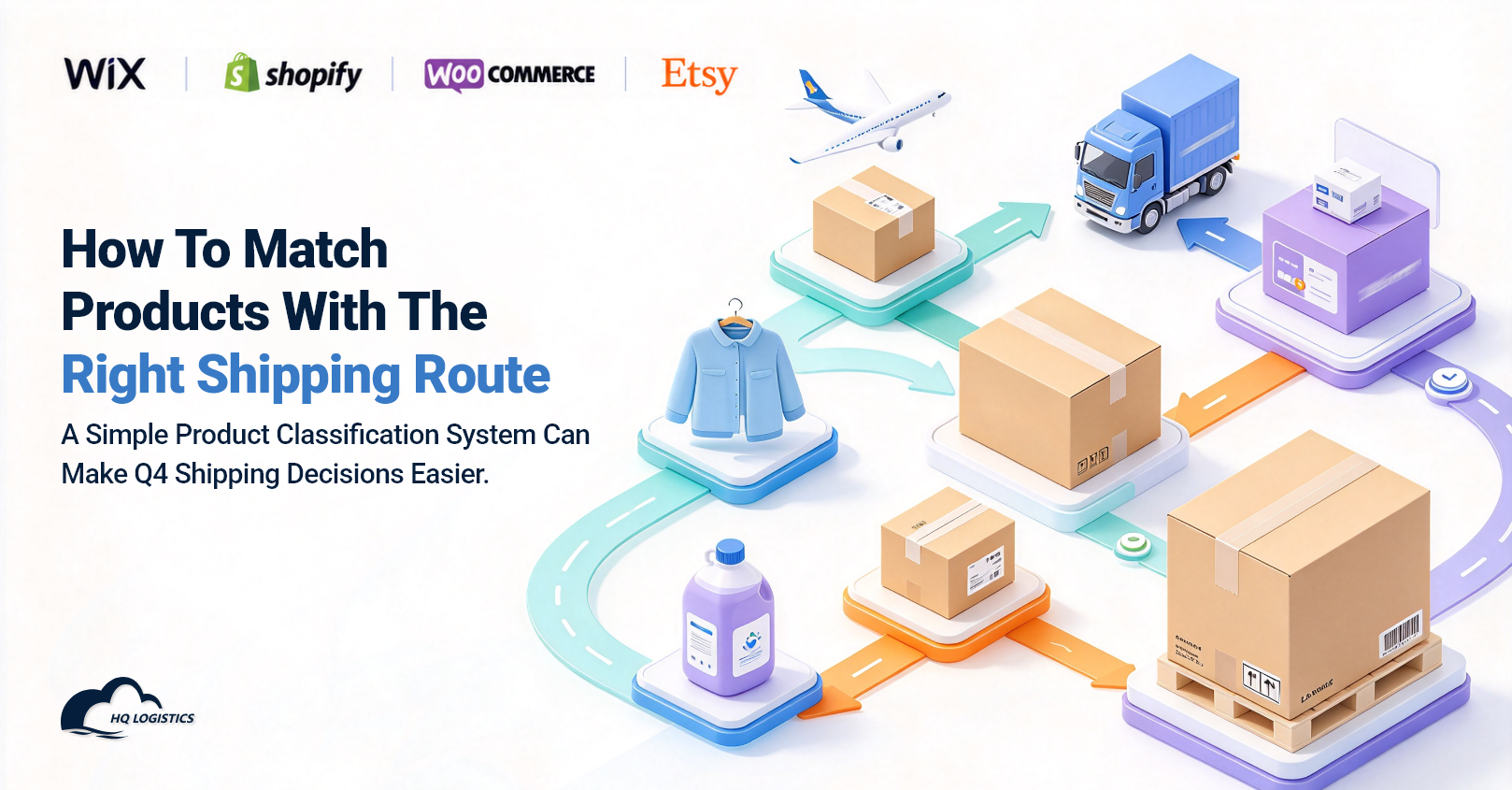
A simple product classification system can make Q4 shipping decisions easier.
These products generate consistent order volume.
Consider faster shipping routes, local fulfillment, or overseas warehousing.
These products have increasing demand but less predictable volume.
Use flexible shipping options and monitor sales closely.
These products are still being tested.
Avoid moving excessive inventory overseas before demand is confirmed.
This approach allows you to spend more logistics resources on the products that have the greatest impact on your Q4 sales.
Shipping route selection and packaging should be considered together.
Poor packaging can lead to damaged products, returns, and additional shipping costs.
For Q4 products, consider:
Product protection | Package size | Dimensional weight | Product presentation | Custom packaging | Warehouse packing efficiency
Oversized packaging can increase shipping costs even when the product itself is lightweight.
At the same time, packaging that is too weak can increase the risk of damage during transportation.
The right packaging should balance protection, cost, branding, and fulfillment efficiency.
A strong Q4 shipping plan can be prepared in several steps.
Look at:
Order volume | Shipping costs | Delivery times | Delayed shipments | Customer complaints | Return rates
Identify which routes performed well and which created problems.
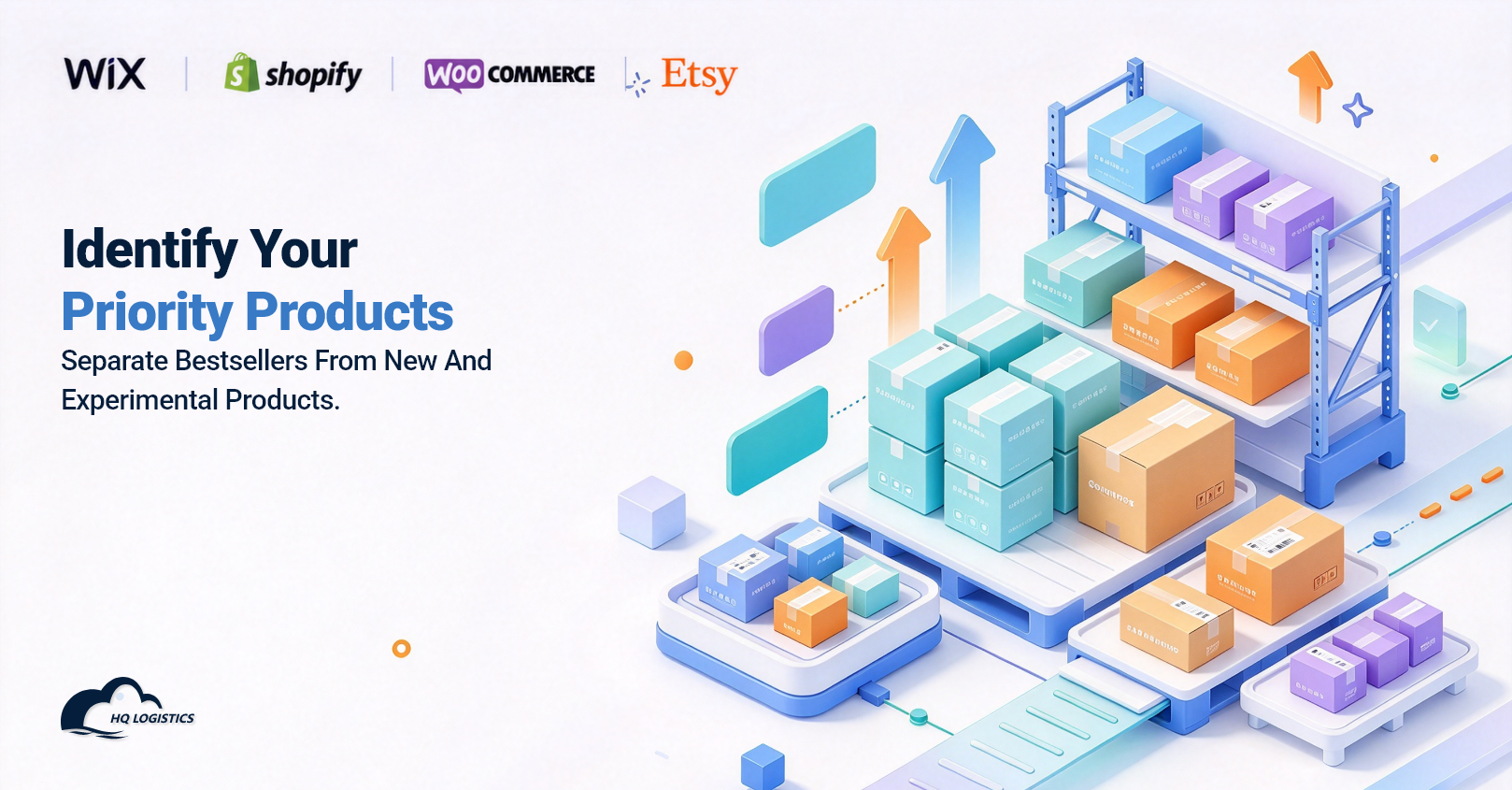
Separate bestsellers from new and experimental products.
Your highest-volume products should receive the most attention.
Compare:
Cost | Transit time | Product eligibility | Tracking | Destination coverage | Peak-season capacity
Don't choose based on price alone.
If you're switching to a new route, test it before sending a large volume of orders.
Check actual delivery time, tracking quality, packaging performance, and customer experience.
Identify alternative routes for your most important products.
A backup route may not be used every day, but having one available can help reduce disruption when conditions change.
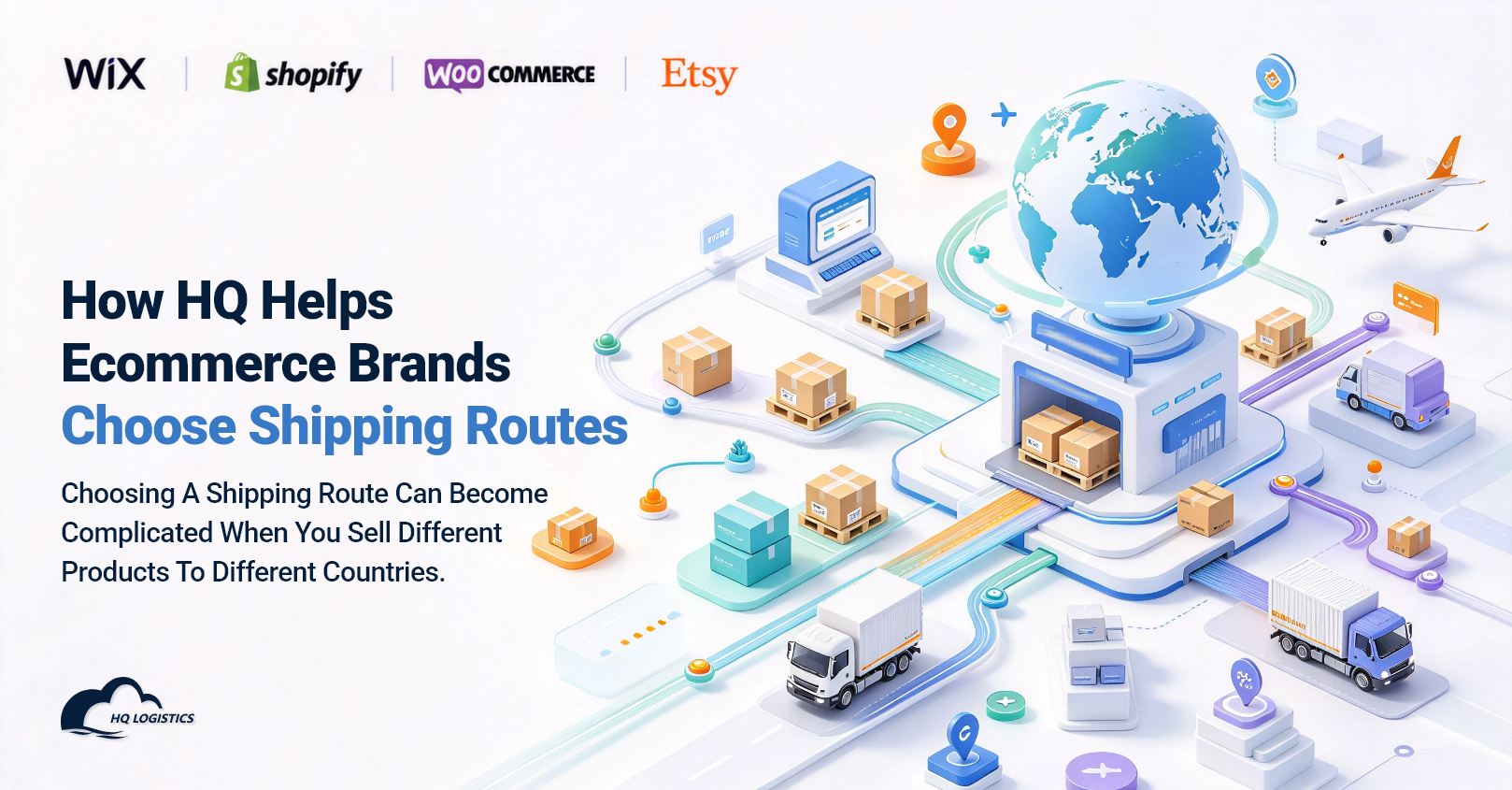
Choosing a shipping route can become complicated when you sell different products to different countries.
HQ can help ecommerce brands coordinate product sourcing, quality inspection, warehousing, packaging, fulfillment, and global shipping through one connected supply chain.
Instead of looking at transportation separately, the shipping strategy can be planned around:
Product → Destination → Order Volume → Inventory Location → Fulfillment Method → Shipping Route
HQ supports multiple suppliers and shipping channels, allowing brands to compare options based on product type, destination, cost, and delivery requirements.
For eligible products and routes, HQ offers 3–8 day delivery options.
For growing brands, fulfillment capacity can reach 20,000 orders per day, helping support higher order volume during peak season.
Eligible brands processing 50+ orders per day can also access free custom packaging support, allowing packaging to be planned together with fulfillment and shipping.
The goal is not simply to find the cheapest shipping route.
It is to build a shipping strategy that can continue working when your order volume increases.
Before peak season begins, review these questions:
Cost: Is the total fulfillment cost competitive?
Speed: Can the route meet your expected delivery window?
Product: Is your product accepted on the route?
Destination: Does the route support your main customer markets?
Capacity: Can the route handle your expected Q4 volume?
Tracking: Can customers track their orders?
Packaging: Is the product properly protected and efficiently packed?
Inventory: Should some products be moved closer to customers?
Backup: Do you have an alternative route for priority products?
Fulfillment: Can your warehouse process increased order volume?
If several answers are unclear, now is the right time to review your shipping strategy.
There is no single best route for every product. The right option depends on product type, destination, order volume, delivery requirements, shipping cost, and peak-season capacity.
Overseas warehousing can be useful for proven products with predictable demand in a specific market. It allows inventory to be positioned closer to customers and can support local fulfillment.
No. A cheaper route may have longer transit times or less predictable delivery. Compare total fulfillment cost, delivery speed, tracking, reliability, and product requirements before choosing.
Ideally, shipping routes should be reviewed before peak demand begins. Give yourself enough time to compare routes, test new options, position inventory, and prepare backup solutions.
Yes. A hybrid shipping strategy can be useful. Bestsellers may use overseas warehousing or faster routes, while new or long-tail products can remain on more flexible direct-shipping solutions.
A fulfillment partner can help coordinate sourcing, quality control, inventory, warehousing, packaging, order processing, and shipping routes. This allows sellers to build a shipping strategy around the entire supply chain rather than transportation alone

Choosing the right shipping route for Q4 is not simply about finding the lowest price.
The best route should balance cost, speed, product requirements, destination, order volume, reliability, and customer expectations.
For some products, direct international shipping may be the most flexible option.
For proven bestsellers, overseas warehousing and local fulfillment may provide better speed and cost control.
For growing brands, a hybrid strategy can provide the flexibility needed to manage both new products and high-volume SKUs.
Most importantly, don't wait until Q4 orders start surging to review your shipping routes.
Plan earlier. Compare smarter. Ship faster. Prepare for peak season.
📩Email: zoye@fulfllment-cn.com
PREVIOUS RECOMMENDATIONS


Q4 shipping, Q4 shipping strategy, how to choose a shipping route, best shipping route for Q4, Q4 fulfillment, peak season shipping, holiday shipping strategy, Shopify shipping strategy, Shopify Q4 fulfillment, ecommerce shipping routes, Q4 logistics, Q4 ecommerce fulfillment, holiday fulfillment, peak season fulfillment, international shipping for ecommerce, overseas warehousing, local fulfillment, hybrid fulfillment strategy, China fulfillment center, China to US shipping, China to Europe shipping, fast shipping for Shopify, 3–8 day delivery, Q4 shipping planning, Q4 inventory planning, ecommerce logistics strategy, global fulfillment for Shopify sellers, shipping route optimization, Q4 supply chain, holiday shipping preparation.




Customer's favorable comments is our eternal motivation. We feel grateful for all the support and company.

Lorem ipsum dolor sit amet, consetetur sadipscing elitr, sed diam nonumy eirmod tempor invidunt ut labore et dolore magna aliquyam erat, sed diam voluptua.